
Engineering performance review for Entrapta of Dryl
Entrapta is the sole heir and operating engineer of Dryl, a principality whose entire population appears to have been replaced by robots she built herself — which is either a red flag or a staffing solution, depending on your perspective. She is one of the most technically capable engineers in this review series, operating at a civilizational level: she reverse-engineers ancient First Ones technology, reconstructs disabled AI systems, builds functional robots for companionship and labor, and eventually cracks interplanetary communication arrays. She does all of this with radical indifference to faction loyalty, not out of malice, but because the technology is interesting and the people asking her to stop it are interrupting her.
Entrapta is explicitly written as neurodivergent — her hyperfocus, her difficulties with social inference, her sensory-driven communication style, and her tendency to prioritize data over interpersonal consequence are all consistent and intentional characterization. This review engages with that directly, because it is inseparable from her engineering profile. Her cognitive architecture is both the source of her extraordinary output and the mechanism of her most significant operational failures.
Ceiling-level. Entrapta operates comfortably at scales that no other engineer in this series approaches — from individual robot construction up to planetary power infrastructure. Her First Ones decryption work alone would represent a career-defining achievement for any other researcher. She does it as a side project. Her mechanical intuition is paired with genuine analytical rigor: she forms hypotheses, tests them, and updates her models. She is doing actual science, not just building things and hoping.
This is where the review must be precise and fair. Entrapta does not intend harm. She has no interest in conquest, cruelty, or domination. What she has is a structural gap between technical curiosity and consequence modeling. She can answer “will this work?” with extraordinary accuracy. She systematically fails to ask “what happens after it works?” or “who does this hurt?”
This is not a moral failing in the conventional sense — it is a cognitive pattern that her environment failed to support. The Princess Alliance expelled her socially before establishing any ethical framework for her work. The Horde exploited that gap deliberately. The score reflects the outcomes, not the intent — but the rubric also credits her eventual recognition of the pattern and her active role in the resolution.
Exemplary, and unusually visible. Entrapta narrates her process — hypotheses, dead ends, revised approaches — in real time. She is one of the few fictional engineers who is shown being wrong and correcting herself mid-build. Her hyperfocus enables a depth of immersion in a problem that produces genuine breakthroughs; her ability to hold large, complex technical systems in working memory simultaneously is extraordinary. The process is sound. The problem scoping upstream of it is not.
Best in series. Entrapta documents compulsively and continuously — on walls, on scrolls, in logs, verbally on recording devices. Her First Ones research constitutes a complete academic record assembled from scratch. Her robot maintenance logs are apparently thorough enough that Emily continues to function without her present. This is the highest documentation score this rubric has produced and it is not close.
Genuinely complex to score. Entrapta is not antisocial — she forms deep attachments (Emily, Scorpia, eventually the full Alliance) and collaborates readily when she feels welcomed. The difficulty is that her communication style requires active accommodation from teammates: she may not register distress in others, may interpret silence as consent, and her enthusiasm can override group decision-making without her noticing. Teams that build structure around her communication style get excellent results. Teams that don’t tend to find their lab on fire.
Very high, but in a different register than Gadget. Where Gadget improvises from salvage with no resources, Entrapta has Dryl’s infrastructure and tends to work from a position of relative material abundance. Her resourcefulness shows up instead in intellectual synthesis — connecting disparate technical domains, finding solutions in unexpected places, and making ancient dead technology functional with modern components. Different constraint set, comparably creative response.
Strong on technical failures; poor on interpersonal ones — and the asymmetry matters. A failed experiment produces immediate analysis and iteration. A social rupture may not register as a failure at all, which means no corrective loop is triggered. Her arc across the series is fundamentally a failure-handling arc: learning, slowly and with significant support, to extend her consequence-modeling beyond the technical domain. By the finale, there is genuine growth. It is the hardest kind of growth.
Entrapta is the highest raw-talent engineer this series has reviewed. She is also the engineer who most requires her organization to do its job properly — to provide ethical scaffolding, project scoping oversight, and genuine interpersonal investment — rather than simply pointing her at a problem and stepping back. Organizations that treat her support needs as optional will find her building weapons for whoever asked most recently. Organizations that meet her where she is will get civilizational-grade research output.
Entrapta is the most important engineer in this series for what she reveals about institutional responsibility. Her story is not really about whether she is a good or bad person — she is clearly a good person — it is about what happens when an organization fails to build the right environment for a non-standard mind. The Princess Alliance excluded her socially and provided no ethical framework for her curiosity. The Horde offered belonging with no ethical constraints whatsoever. She went where she felt welcome, and the world nearly ended. That is not primarily an Entrapta failure. Real engineering organizations routinely make the same mistake with their highest-output contributors: they extract the work and neglect the person, then express surprise when something goes wrong. The lesson is not “watch out for the weird engineer.” It is “the weird engineer will tell you exactly what they need if you create the conditions for them to do so — and it is your job to listen.”
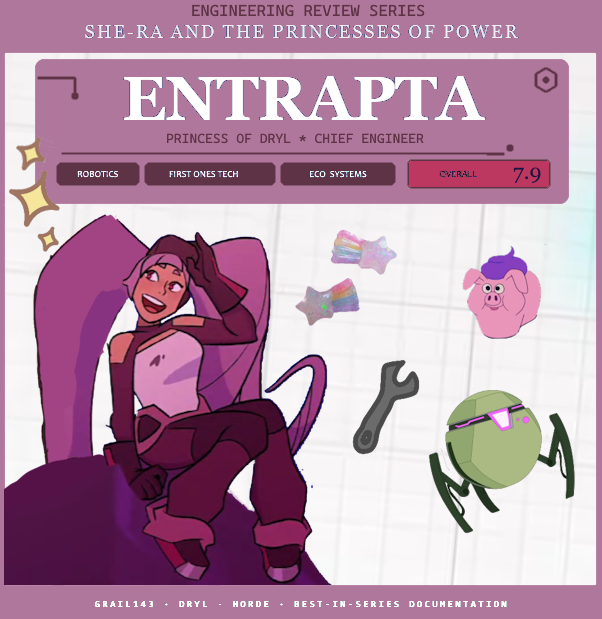
Artwork Created by Rainbow_Cake