
Keira is the daughter of Samos Hagai, the Green Sage of Sandover — the foremost living authority on eco in the known world. This is the foundational fact of her engineering identity, and it cuts both ways. She inherits an eco-first technical intuition that no formal institution could replicate, a deep instinctive understanding of the energetic substrate underlying all technology in her world. She also inherits the particular burden of being the capable daughter of a famous man in a world that tends to credit him first.
Across the full franchise — from Sandover Village to Haven City to Kras City to the events of the Daxter PSP arc — Keira’s engineering practice evolves from competent support mechanic to independent vehicle technician to full racing team principal. The arc is real professional development, not just cosmetic. By Jak X she is running her own operation, making her own calls, and answering to no one. That is the data point the verdict hinges on.
Strong and consistently underestimated, including by the franchise itself. Keira operates across two domains simultaneously: conventional mechanical engineering (vehicle construction, maintenance, field repair) and eco-systems integration (understanding how dark, light, red, blue, and green eco interact with mechanical components). The second domain is genuinely rare — most mechanics in the Jak universe work with eco as a fuel source without understanding its underlying properties. Keira understands the properties. That depth shows in her field improvisations, which consistently produce solutions that go beyond what a pure mechanic would reach.
Being raised by the Green Sage means Keira’s earliest technical education was eco-first, conducted by the foremost living expert in the field, in an environment (Sandover Village) where the relationship between eco and the natural world is still intact and observable. This is an extraordinary foundation that no formal engineering program could replicate. The liability is equally real: she internalises Samos’s framing of problems, which is philosophical and long-cycle, before she develops her own shorter-cycle iterative engineering instincts. Her early-game problem-solving carries his fingerprints. By Jak X, those fingerprints are gone. What remains is hers.
Consistently strong ethical alignment — she builds for survival, resistance, and competition, never for harm. Her safety record is complicated only by the environments she operates in: KG-occupied Haven City is not a safe workshop by any standard. She manages risk pragmatically and without recklessness. No significant design-caused failures attributable to her work appear in the franchise record.
Iterative and pragmatic — a direct contrast to Samos’s more contemplative approach. Keira identifies a mechanical problem, maps available materials and eco resources, and produces a working solution. She does not overengineer. She does not wait for ideal conditions. The Haven City arc is the clearest demonstration: she maintains a functional vehicle fleet for the Underground with zero supply chain, zero downtime budget, and zero margin for error, across the entire game. That is sustained operational engineering under maximum constraint, and it holds.
Poor, and this is a genuine gap. There is no evidence across the franchise of Keira maintaining build logs, vehicle service records, or eco research notes — despite the fact that her eco research work in the first game and Jak 3 would have significant archival value. Her knowledge appears to be retained personally and transmitted verbally. This is the standard for her world, which has no apparent engineering documentation culture, but the rubric applies a consistent standard: the knowledge exists only while Keira does, and that is a fragile institutional situation.
Functional and improving across the franchise arc. In the early games she is primarily in a support role and communicates through briefings and updates — clear and efficient, but asymmetric. By Jak X she is directing a team rather than supporting one, and the shift in her communication style is visible: she gives instructions, makes calls under time pressure, and manages multiple team members simultaneously. The Jak X arc is where her leadership competency becomes unambiguous.
High, and calibrated to a world where eco is both fuel and force multiplier. Her ability to integrate eco properties into mechanical solutions gives her a resource palette that conventional mechanics don’t have access to. In Haven City this is especially significant — she is not just working with what’s left behind, she is working with what’s energetically available, which in a city built on dark eco infrastructure is a genuinely complex and dangerous materials environment. She navigates it without incident.
The franchise does not give Keira many visible mechanical failures to respond to, which is itself a data point — her builds tend to hold. Her interpersonal failures (the friction with Jak across Jak II and Jak 3, the arc around trust and communication with him) are handled with more maturity than the games’ framing sometimes credits her for. She does not catastrophise. She continues working. The Mar Vista Garage keeps running regardless of what is happening in the larger plot.
Keira is a mature, multi-domain engineering practitioner whose franchise arc is a case study in what happens when a capable engineer is consistently placed in a support role that undersells her actual competency. The Jak X arc demonstrates what she produces when given full operational ownership: a functional, competitive racing operation built and run entirely on her own terms. Any organization hiring Keira should structure her role as principal from the start. Placing her in support is not a stepping stone — it is a waste.
Keira’s story is about what the industry calls the support trap — the pattern where a capable engineer is hired into a supporting role because of their relationship to someone more famous, and then kept there by institutional inertia long after they have outgrown it. She is not Samos’s assistant. She is an engineer who happened to be raised by Samos, and those are different things. The real-world parallel is common: junior engineers who are technically ready for senior roles but are held at the support level because they were hired through a senior colleague’s network, or because the organisation has not updated its mental model of them since their first day. The fix is not patience. It is structural — give people ownership early, evaluate them on what they build when no one is looking over their shoulder, and update your assessment as the evidence updates. Keira, left alone in the Mar Vista Garage, builds a functioning independent operation. That is the evidence. The franchise just takes four games to notice it.
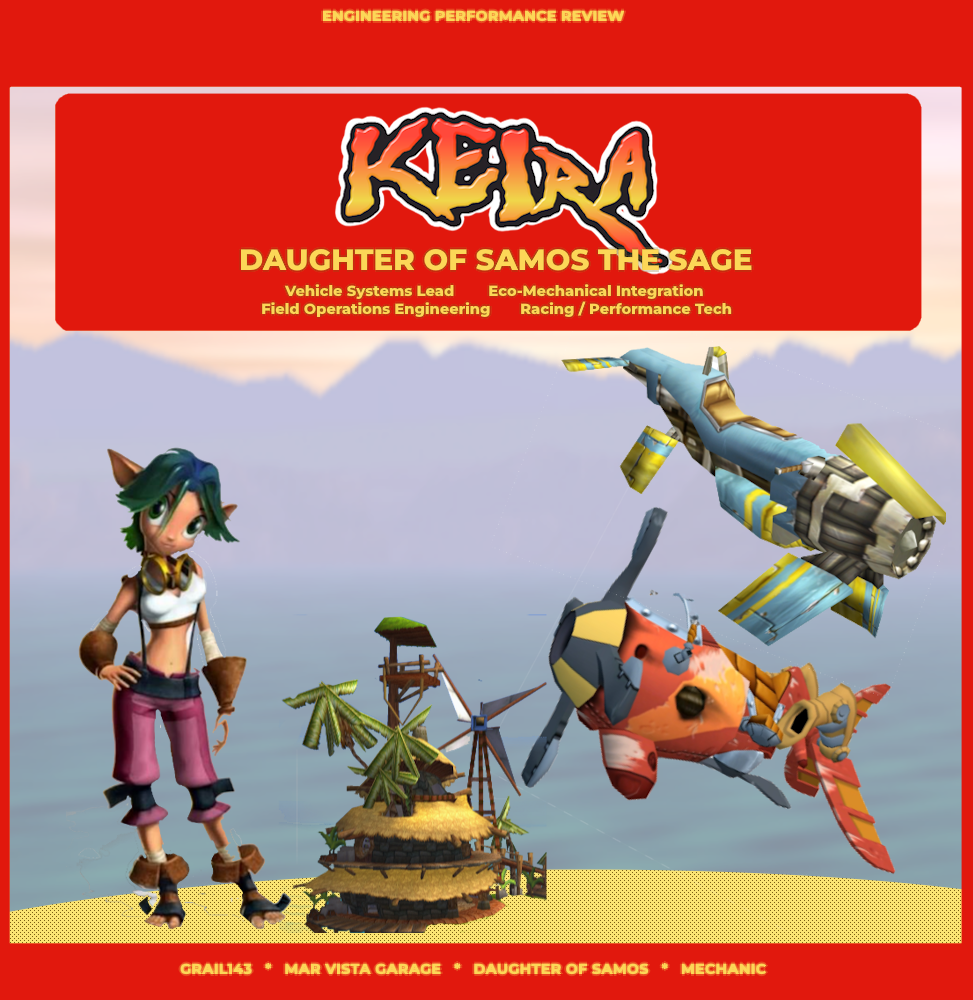
Artwork by Rainbow_Cake